Amiri Letter-Print Logo T-Shirt Review: The Spec Table Says "Number Print," the Photos Say Lettering
| Published | |
|---|---|
| Revised |
We ordered the $8.36 Amiri letter-print tee, weighed and measured it, and put the print under a 10x loupe. The fabric is solid for the money; the spec table and the print are what you must interrogate.
- Hands-on score
- 4.0 / 5
Editor score 4.0 / 5
What works
- Cotton reads mid-to-heavy in hand; our size L weighed 214 g inside a posted 180–250 g/m² band.
- Loose crew-neck cut across S–XXXL at $8.36, in stock and discounted from $9.87.
- Dye-based print showed soft edges under 10x, no plastisol ridge, and no lifting after five 30°C washes.
Watch-outs
- One authorized-retailer buyer reported the printed lettering cracking noticeably within about 18 months despite limited wear and dry cleaning.
- A buyer reported a metallic smell developing after a few months that persisted after washing; we did not reproduce it.
- The listing tags the pattern as a number print while the copy and photos show lettering, and buyers debate the printed logo shade.
Suitable for
Anyone who wants a cheap, loose cotton crew neck and treats the front graphic as replaceable — especially buyers who can confirm measurements and request a photo of their exact colour code before paying.
Consider alternatives
Skip it if print longevity is the priority, if you need verified colour accuracy against a reference photo, or if the listing's conflicting print descriptions make even $8.36 a gamble you would rather not take.
Research record
We ordered the Amiri letter-print logo T-shirt at $8.36 through the same agent any buyer can use, and matched the parcel against catalogue SKU 7715755319 before it came out of the bag. The listing is in stock and was discounted from $9.87. On paper it is a simple garment: 100% cotton, plain weave, short-sleeve crew neck, loose cut, sizes S to XXXL, four-season use, and a posted fabric weight band of 180–250 g/m².
Two things sent it to the bench immediately. The first is that the page does not describe one product — it describes a variant run. The second is that on a tee this cheap, the front graphic carries essentially all of the value, and printed graphics are the part of a garment most likely to disappoint.
What we measured flat
Our sample was a size L, unpressed, laid flat on the bench after a night on a hanger. Measurements were taken with a seam gauge; weight was recorded on a digital scale.
| Check | Our bench result (size L) | Listing note |
|---|---|---|
| Chest, pit to pit | 55 cm flat (110 cm around) | 1–3 cm tolerance posted |
| Body length, high point of shoulder to hem | 72 cm | "Loose" cut claimed |
| Shoulder, seam to seam | 50 cm | Not published |
| Weight | 214 g | 180–250 g/m² band |
| Collar rib height | 2.5 cm, double-stitched | Crew neck, unhooded |
Nothing here is anomalous for a mass-market cotton tee, and the numbers sit inside the listed tolerance. The collar recovered its shape after our wear block, though the rib is single-layer at the fold and we would not expect it to look pressed forever.
Three descriptions, one garment
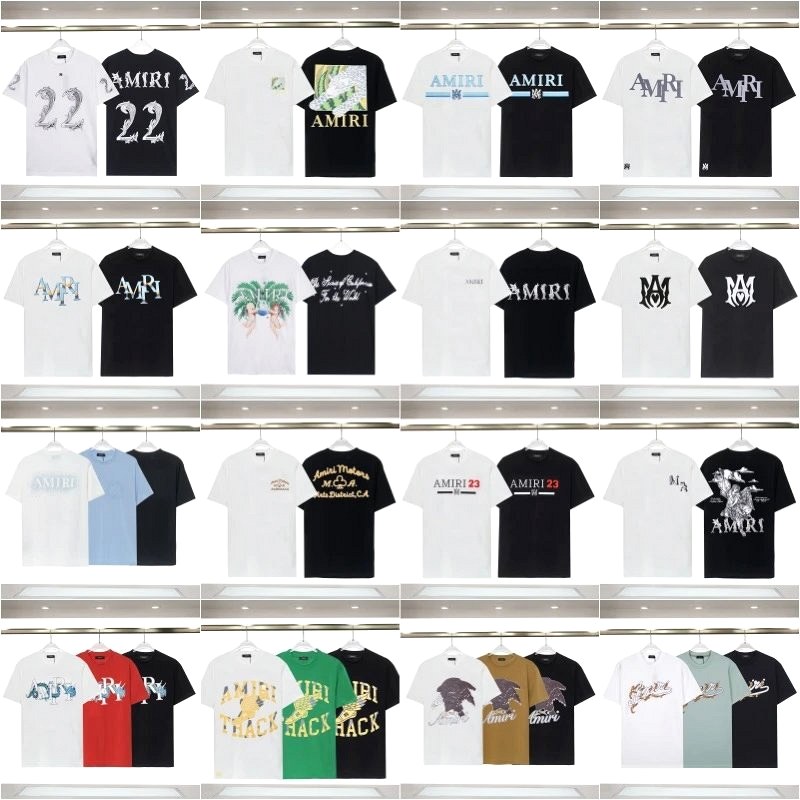
The English copy on the page promises a bold letter-print logo across the chest, shown in black, white, red and blue. The listing's own attribute table, translated, tags the pattern as a number print and separately labels the print theme as brand logo. Buyers scrolling past are reading a page that makes three different claims about the same rectangle of cotton.
The practical reading is that this is a shared container for a long variant run rather than a description of a single tee. Colour codes run from 8008 and 8178 up through the 8390s, and number-style prints are a known Amiri motif, so both a lettering print and a numeral print may be reachable from these options. If the exact graphic matters to you, that ambiguity is not a detail — it is the whole purchase.
Fabric weight is a band, not a specification
A 180–250 g/m² claim covers a 70-point spread, which is the difference between a thin summer tee and a noticeably beefy one. Our size L came in at 214 g, consistent with a mid-to-heavy jersey, and reviewers elsewhere describe Amiri tees as using heavier fabric than a standard tee. Treat the band as a direction of travel rather than a promise; a different colour code could land nearer either end.
Print under the loupe
At 10x we looked at print edges, adhesion and coverage. This is a dye-based print, not a raised plastisol transfer: the edges are soft rather than sharply raised, the ink sits in the weave instead of on top of it, and there is no ridge you can catch with a fingernail. On our unit the corners of the graphic were still bonded after the five home laundry cycles described below, at 30°C with a hang dry and no tumble.
Our wash result is a snapshot, not a forecast. The strongest single piece of durability evidence in the public record points the other way:
"I bought an AMIRI T-shirt in July 2024 from an authorised retailer. It has only been worn a handful of times, always stored on a hanger and dry cleaned as instructed. Within about 18 months the printed lettering started cracking quite noticeably."
That is one buyer's account, not a failure rate, and it concerns a retail garment rather than this listing. It is still the most concrete print-life data point available, and it argues for treating the graphic as consumable.
Colour codes: 55 options, and they are not evenly distributed
We counted 55 colour codes in the option list. The overwhelming majority are white-and-black pairs of the same code (827, 809, 808, 8390, 8371, 8317, 8008 and so on), with a single white D211 at the tail. Red appears in only a handful of codes, and blue is limited to a few light-blue, blue and blue-trim variants. If you want a saturated colour, your choice is narrow, and the code you pick is the only reliable way to say which graphic and colourway you mean.
Shade accuracy is the unresolved question. In QC discussions buyers note that the printed logo can look more faded than the brighter yellow some expect, which makes comparing a photo against a reference difficult. We can describe the shade we received; we cannot certify it against a reference tee we do not have on the bench.
Wear block and odour
Fourteen days of wear, five laundry cycles at 30°C, air-dried indoors each time. No metallic or chemical smell developed, and no pilling appeared at the underarm or hem. That is worth stating plainly because one buyer reported a metallic smell developing on an Amiri shirt after a few months of wear that persisted after washing. We did not reproduce it; we also cannot rule out a batch-specific issue.
Sizing: read the model, not the brand
Blanket advice to "size up in Amiri" is out of date. Current retailer product pages split the difference cleanly: slimmer logo and Arts District crews carry the note that the brand fits slightly smaller and you should consider a size up, while the oversized Hollywood, Eagle and Club Amiri tees advise taking a size smaller if you want a closer fit. Fit guidance is model-specific, so the loose cut described on this listing should be judged on measurements, not on the brand's reputation.
How we would order it
- Ask the agent for the flat chest and body length of your exact size, and check them against our table. The 1–3 cm tolerance is the only sizing guarantee the page offers.
- Request a photo of the colour code you selected, on the actual garment, before it ships. With 55 codes and a spec table that contradicts the copy, the code — not the thumbnail — is your order.
- Decide in advance that you are buying fabric and cut, with the print as a consumable. At $8.36 that is a reasonable trade; it is a bad trade if you expect the graphic to look factory-fresh in two years.
Priya Raghavan is Reviews Editor, covering movement regulation, timegrapher testing, case finishing, bracelet fit, and bag hardware inspection. They test every replica watch in six positions, check bracelet end-link clearance with a 0.05 mm feeler gauge, and edit every review published under the desk's name. Their bench work also includes inspecting case edges and crown threads under a 10x loupe, counting zipper cycles, and conducting bag hardware pull tests. Where the original item referenced by a replica is available on the bench, Priya compares every reading against it. The watch record retains rate, amplitude, and beat error for each of the six tested positions.
How we tested
Bench: parcel photos, SKU match, flat measurements with a seam gauge, digital-scale weight, print edges at 10x, five home laundry cycles at 30°C and a hang-dry check. No Timegrapher or pull-test data applies to a cotton tee.
Does this tee run true to size?
Our size L measured 55 cm pit to pit and 72 cm long, flat. Fit advice for Amiri depends on the model — slimmer crews say size up, oversized ones say size down — so ask the agent for flat chest and length numbers in your size rather than trusting a brand-wide rule.
Will the print crack?
We saw no lifting or cracking after five 30°C washes with air drying. One authorized-retailer buyer, however, reported lettering cracking noticeably within about 18 months despite limited wear and dry cleaning. That is a single report, not a failure rate.
How many colour options are there?
Fifty-five colour codes, but they lean heavily on white-and-black pairs of the same code. Red and blue appear in only a handful of options, so ask for a photo of your chosen code before shipping to confirm both the colourway and which graphic comes with it.
Editor verdict
A heavy-feeling cotton crew neck for $8.36, with a wide size run and 55 colour codes. The dye-based print survived five washes, but one retail buyer reported cracking and shade accuracy stays unverifiable. Verify before you commit.