Carhartt Jacket Packing Costs: Volume, Weight & Route Limits
| Published | |
|---|---|
| Revised |
# Carhartt Jacket Packing Costs: Volume, Weight & Route Limits  Image: Verifiable product information entry in the Carhartt jacket category page on [Fashionreps](https://fashion-reps.net/). ## The fee problem this Carhartt fall/winter jacket consolidation aims to solve If you plan to ship a Carhartt fall/winter jacket together with other items, what you really
Editor score 4.2 / 5
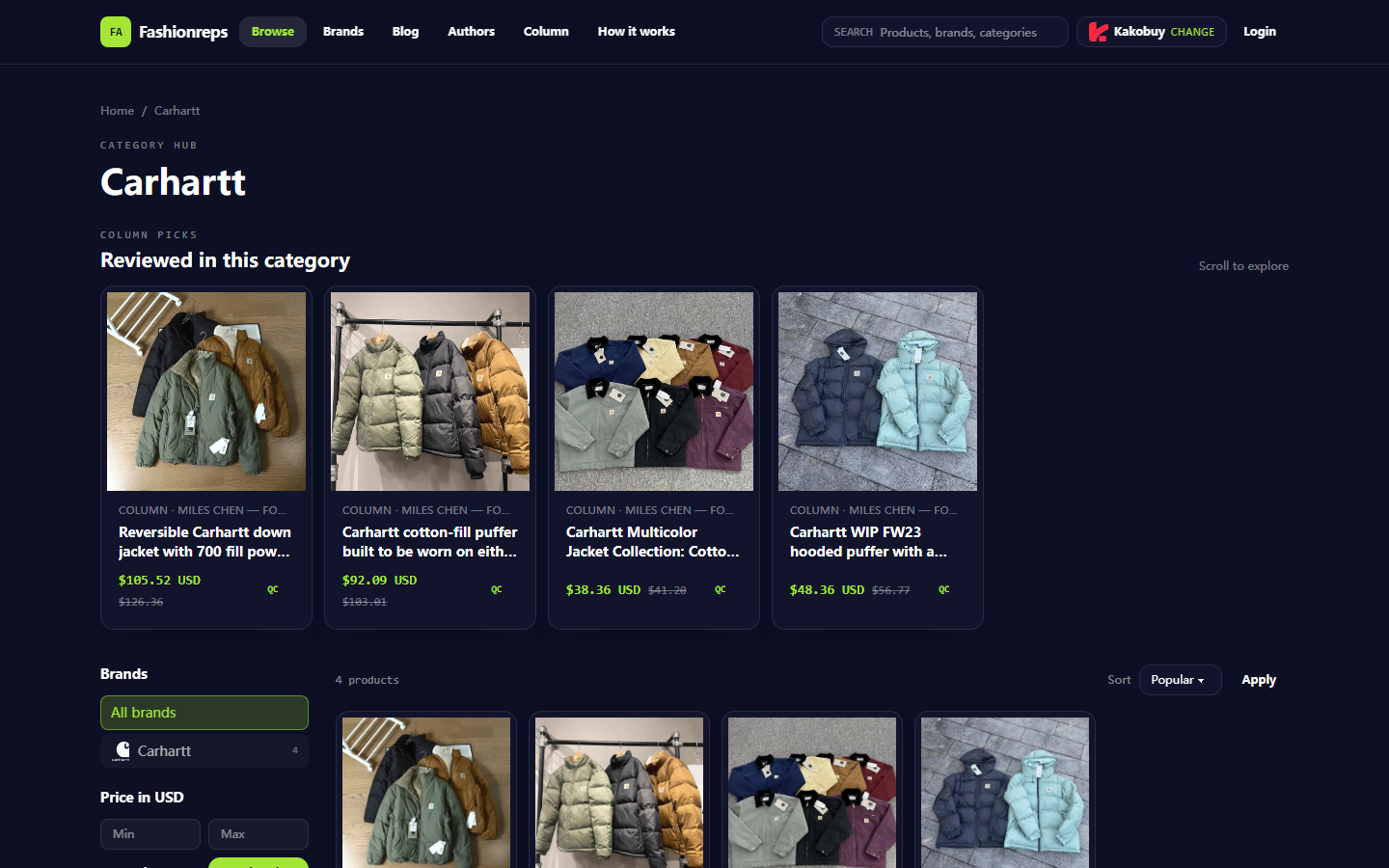

Image: Verifiable product information entry in the Carhartt jacket category page on Fashionreps.
The fee problem this Carhartt fall/winter jacket consolidation aims to solve
If you plan to ship a Carhartt fall/winter jacket together with other items, what you really need to judge is not "is consolidation always cheaper?" but rather whether consolidation changes the chargeable weight, packing volume, route eligibility, and risk of a single package.
This article is for buyers who have found the target item on fashion-reps, are ready to proceed with checkout through their chosen shopping agent, and need to decide at the warehouse stage whether to consolidate, split, or hold shipping. After reading, you should be able to do four things:
- Record the item amount, agent service fee, payment fee, packing fee, and international shipping fee.
- Distinguish between actual weight, volumetric weight, and route limits.
- Compare consolidation and splitting under the same destination and packing conditions.
- Hold off when evidence is insufficient, rather than guessing the final shipping cost from product images.
This article does not apply to scenarios where you need instant quotes for a specific route, customs amount, or stock for a particular size. That information must be re-queried under the target agent and destination country conditions.
Verify the target jacket page, size, style, and currently visible information
The Carhartt category page on Fashionreps displays multiple jacket entries, including reversible down jackets, cotton-filled jackets, multi-color jacket series, and hooded Carhartt WIP jackets. The page also shows USD reference prices, but these are reference information visible at the time the page was viewed and do not equal the current transaction price, agent settlement price, or final landed cost.
This draft does not use these reference prices as current prices, because product prices, inventory, seller pages, link status, and agent fees may change. Before publishing or placing an order, you should reopen the specific product page and confirm the following:
- Whether the product title matches the target style.
- Whether the required size and color are still selectable.
- Whether the page has enough product information to support a purchase decision.
- Whether the product link opens normally, or if it redirects, becomes invalid, or turns into a blank page.
- Which shopping agent the buy button jumps to.
- The item amount, exchange rate, service fee, and payment method displayed on the agent page.
The Fashionreps page states that users can choose a shopping agent, and the buy button will jump to the selected agent's website; orders, payments, and shipping are handled by the agent's website. Therefore, the category information on the fashion-reps page cannot replace the agent's real-time quote.
Record jacket quantity, folding method, packing requirements, and estimated dimensions
Before consolidation, create a warehouse record. At minimum, record the jacket quantity, size, whether it has a hood, whether it has thick filling, original packaging condition, and the actual weight and outer box dimensions provided by the warehouse.
Do not equate "fall/winter jacket" directly with a fixed weight. Down, cotton filling, thick fleece, hard shell fabric, hood structure, and large sizes can all affect the compressed volume. Product images can only help confirm the style; they cannot prove weight, warmth, or compressed outer box dimensions.
It is recommended to ask the warehouse for or confirm:
- The actual weight of a single item.
- The length, width, and height after a single item is packed.
- Whether removing shoe boxes, hangers, brand cardboard boxes, or excess outer packaging will change the dimensions.
- Whether re-folding, compressing, or replacing the outer box is allowed.
- Whether repacking incurs a service fee.
- Whether repacking increases the risk of wrinkles, crushing, or transit damage.
- The final weight and dimensions of the consolidated package.
If the warehouse has not yet provided actual measurement data, you can only make process judgments and cannot output specific shipping costs or savings amounts. 📦
Distinguish item amount, service fee, packing fee, and international shipping fee
The total expenditure for a Carhartt jacket should be broken down into different items to avoid mistaking the price on the product page for the landed cost.
| Fee item | Evidence to record | What cannot be directly inferred |
|---|---|---|
| Item amount | Currency, amount, size, and stock on the specific product page or agent settlement page | Cannot use category page reference price as current transaction price |
| Shopping agent service fee | Agent order page or official fee description | Cannot assume all agent rates are the same |
| Payment fee or exchange cost | Information displayed on payment page, bank card, or payment service provider | Cannot treat exchange rate differences as fixed fees |
| Packing or warehouse service fee | Actual quote after warehouse submits packaging request | Cannot estimate from jacket images |
| International shipping fee | Destination, chargeable weight, volume, route, and real-time quote | Cannot calculate based on number of items or product price alone |
| Taxes and customs clearance costs | Destination country rules, carrier notification, or actual bill | Cannot guarantee the package will be duty-free |
You can use the following structure for calculation:
Total item amount = sum of each item's amount
Comparable package cost before shipping = packing service fee + international shipping fee + known payment or exchange cost
Possible final expenditure = total item amount + comparable package cost before shipping + possible taxes or customs fees in the destination country
The formula itself is not a quote. Only when the destination, currency, actual weight, outer box dimensions, route, and query time are clear does the calculation result have comparative meaning.
Query official routes with unified destination and package conditions
When comparing consolidation and splitting, you must fix variables. At least keep the following conditions consistent:
- Same receiving country and region.
- Same postal code or acceptable destination range.
- Same currency.
- Same query time.
- Same item declaration information and packaging requirements.
- Same removal of excess outer packaging or not.
- Same insurance, value-added services, and signature conditions.
Then query three scenarios separately:
- One jacket shipped alone.
- Jacket consolidated with other clothing.
- Jacket consolidated after removing non-essential outer packaging.
Record the quote basis, chargeable weight, volumetric weight, route name, estimated transit time, prohibited or restricted shipping notes, and quote validity for each scenario. If the agent only shows a total price without weight or route details, mark the evidence completeness as insufficient, and do not break the total price into unspecified fictitious items.
Route limits may include size limits, weight limits, clothing category restrictions, declaration requirements, remote area surcharges, insurance coverage, and destination country customs requirements. If the jacket and other items exceed limits after consolidation, splitting may be a compliance requirement, not just a price choice. 🚚
Compare verification conditions for consolidation, splitting, and removing outer packaging
The potential benefit of consolidation is reducing duplicated fixed operational fees and possibly reducing the initial weight or base fees incurred by multiple packages. However, if consolidation moves the package into a higher billing tier, triggers volumetric weight, or exceeds route limits, the savings may disappear.
The potential benefit of splitting is reducing the declared value, weight, or size of a single package, and possibly avoiding certain route limits. But splitting usually increases duplicated base fees, packing fees, and tracking records, while increasing the management cost of multiple packages being delayed or lost separately.
Removing excess outer packaging may reduce volume, but you should not write unconfirmed compression effects from the warehouse as certain savings. If the jacket needs to maintain its fill shape, avoid serious wrinkles, or if the packaging itself provides moisture protection, you should not blindly compress to reduce volume.
The final judgment can follow this order:
- First confirm that the product page, size, stock, and purchase link are valid.
- Then obtain actual weight and dimensions from the warehouse.
- Then confirm the packaging methods allowed by the agent.
- Then query consolidation and splitting quotes for the same destination.
- Finally check route limits, declaration requirements, and tax risks.
Do not infer weight, warmth, or final shipping cost from product images
Product images can help confirm color, fit, and structure, but cannot prove the jacket's actual fill amount, fabric weight, compression ratio, or volume after warehouse packing. The reference price on the page cannot infer international shipping, let alone destination country taxes.
The following statements should not be used directly when official or warehouse evidence is lacking:
- "This jacket must be light, so shipping is low."
- "Removing packaging will definitely save a fixed amount."
- "Consolidation is always cheaper than two packages."
- "A certain route will definitely not incur taxes."
- "The page reference price is the final purchase price."
If weight, dimensions, destination, or route quotes are missing, the correct result is to hold off on comparison, not to fill in estimated numbers. 🧾
Final action: decide consolidation, splitting, or hold based on evidence completeness
When the following information is obtained, it is appropriate to submit a packing or shipping request: the specific jacket page is still valid, size and style are confirmed, the warehouse has provided actual weight and dimensions, the agent has given a route quote corresponding to the destination, and has clarified packing fees, restrictions, and possible tax liability.
On this basis:
- If the chargeable weight, volume, and route conditions after consolidation are still within acceptable range and packing risk is acceptable, consolidation can be chosen.
- If consolidation triggers weight, size, declaration, or route limits, splitting scenarios can be compared.
- If only the product reference price is available without warehouse actual data or official route quotes, hold off and do not write uncertain amounts into the budget.
Savings must be calculated by subtracting actual quotes from two verified scenarios, not filled in based on experience. Risks of consolidation include higher single package value, greater impact of one-time loss, increased volumetric weight, route restrictions, and more complex customs handling. Suitable for consolidation are those who have obtained complete warehouse data, have a small number of items, and the target route allows merging; not recommended for consolidation include situations where size or weight is close to route limits, items need special protection, declaration information is not confirmed, or clear quotes cannot be obtained after consolidation.
Verification record
- Main stage: Decision before warehouse packing and international shipping.
- Main problem: How packing volume, chargeable weight, and route limits affect cost comparison after consolidating Carhartt fall/winter jackets.
- Applicable platform identity: fashion-reps product discovery and shopping agent redirect page.
- Product evidence: Visible product entries and page descriptions on the Carhartt category page.
- Current fee evidence: Destination, warehouse actual weight, outer box dimensions, and agent real-time route quotes are not provided, so specific shipping costs or savings amounts are not output.
- Fact verification time: This article is written only based on the page records provided in the current content package; before ordering, you must re-verify product pages, agent quotes, route limits, and destination country requirements.
- Image source: Screenshot of the Carhartt category page on fashion-reps, using the image path provided by the original site.
- Image purpose: Illustrate the target product category page and purchasing agent entry, not as evidence of weight, material, warmth, or shipping cost.
- Editorial byline: Panda-Buy Editorial Desk, this article adopts an editorial perspective to organize public page information and verification methods, and does not claim to have personally purchased, received, worn, or tested the product.
agent platform shopping FAQ
1. What benefits can using a spreadsheet bring to users of kako-sheet.org?
Since agent platforms usually do not directly display product information, you need a spreadsheet to search for desired items and find the corresponding purchase links. Another option is to ask for help on Reddit or Discord; although the products recommended by these communities are often of good quality, the entire shopping process can be time-consuming. Such spreadsheets are generally collected and organized from these channels over a long period.
2. Why doesn't kako-sheet.org use Google Sheets?
Google Sheets is only suitable for spreadsheets with a small number of products. When the number of products increases, loading becomes very slow, the system lags noticeably, especially on mobile devices, the visual experience is poor, and searching for products is extremely inconvenient. For the same batch of products, the spreadsheet on kako-sheet.org loads faster and has a better visual presentation.
3. What product categories are available on kako-sheet.org?
kako-sheet.org offers a wide range of product categories, including shoes, T-shirts, sweaters, hoodies, jeans, sweatpants, shorts, board shorts, factory clearance items, down jackets, baseball shirts, shirts, hats, jewelry, bags, electronics, sunglasses, socks, underwear, and trendy collectibles.
}
Marcus Feldt is Editor in Chief, covering replica sneaker construction, leather grading, stitch and seam durability, and EU import logistics. They write most of the desk's sneaker and leather-goods reviews and maintain its batch-tracking spreadsheet. Tests connect order, warehouse, and delivery dates with bench measurements of weight per shoe, midsole durometer readings, stitch density per 10 mm, and a 30-cycle lace abrasion check. Before wear testing begins, Marcus photographs all six sides of the item and its box label, bringing arrival records, construction measurements, and batch tracking into the review.